



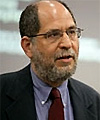
Max Bazerman
In addition to being the Straus Professor at the Harvard Business School, Max is formally affiliated with the Kennedy School of Government, the Psychology Department, and the Program on Negotiation.
Max's research focuses on decision making, negotiation, and ethics. He is the author, co-author, or co-editor of eighteen books (including Negotiation Genius [with Deepak Malhotra], Bantam Books, September 2007) and over 200 research articles and chapters. He is a member of the editorial boards of the American Behavioral Scientist, Journal of Management and Governance, Mind and Society, Negotiations and Conflict Management Research, and the Journal of Behavioral Finance. Also, he is a member of the international advisory board of the Negotiation Journal.
From 2002-2008, Max was consistently named one of the top 40 authors, speakers, and teachers of management by Executive Excellence. He was "Teacher of the Year" by the Executive Masters Program of the Kellogg School. In 2003, Max received the Everett Mendelsohn Excellence in Mentoring Award from Harvard University's Graduate School of Arts and Sciences. In 2006, Max received an honorary doctorate from the University of London (London Business School), the Kulp-Wright Book Award from the American Risk and Insurance Association for Predictable Surprises (with Michael Watkins), and the Life Achievement Award from the Aspen Institute's Business and Society Program. In 2008, Max was named as Ethisphere's 100 Most Influential in Business Ethics, was named one of Daily Kos' Heroes from the Bush Era for going public about how the Bush Administration corrupted the RICO Tobacco trial, (with Deepak Malhotra) received the International Institute for Conflict Prevention and Resolution (CPR) Outstanding Book Award for Negotiation Genius, and received the Distinguished Educator Award from the Academy of Management.
In 2009, Max won both the Wyss Award for doctoral student mentoring and the Williams Award for teaching excellence at the Harvard Business School. His former doctoral students have accepted positions at leading business schools throughout the United States, including the Kellogg School at Northwestern, the Wharton School at the University of Pennsylvania, the Fuqua School at Duke, the Johnson School at Cornell, Carnegie-Mellon University, Stanford University, the University of Chicago, Notre Dame, Columbia, and the Harvard Business School.
His professional activities include projects with Abbott, Aetna, Alcar, Alcoa, Allstate, Ameritech, Amgen, Apax Partners, Asian Development Bank, AstraZeneca, AT&T, Aventis, BASF, Bayer, Becton Dickenson, Biogen, Boston Scientific, BP, Bristol-Myers Squibb, Business Week, Celtic Insurance, Chevron, Chicago Tribune, City of Chicago, Deloitte and Touche, Dial, Ernst and Young, First Chicago, Gemini Consulting, General Motors, Harris Bank, Home Depot, Hyatt Hotels, IBM, John Hancock, Johnson & Johnson, Kohler, KPMG, Lucent, The May Company, McKinsey, Medtronics, Merrill Lynch, Monitor, Motorola, National Association of Broadcasters, Nordstjernen, Pfizer, PriceWaterhouseCoopers, R. P. Scherer, Sara Lee, Siemens, Sprint, Sulzermedica, Synergen, The Nature Conservancy, Unicredito, Union Bank of Switzerland, Wilson Sporting Goods, Xerox, Young Presidents Organization, World Bank and Zurich Insurance.
Max's consulting, teaching, and lecturing includes work in Argentina, Australia, Austria, Barbados, Belgium, Brazil, Canada, Chile, Costa Rica, Ecuador, France, Germany, India, Ireland, Israel, Italy, Malaysia, the Netherlands, Peru, the Philippines, Puerto Rico, Singapore, South Africa, South Korea, Sweden, Switzerland, Thailand, and the UK.
Primary Interests:
- Aggression, Conflict, Peace
- Applied Social Psychology
- Ethics and Morality
- Intergroup Relations
- Judgment and Decision Making
- Organizational Behavior
- Social Cognition
Note from the Network: The holder of this profile has certified having all necessary rights, licenses, and authorization to post the files listed below. Visitors are welcome to copy or use any files for noncommercial or journalistic purposes provided they credit the profile holder and cite this page as the source.
Video Gallery

Pay Attention to Bad Vibes
Select video to watch
-
6:00 Pay Attention to Bad Vibes
Length: 6:00
-
1:45 How to Reduce Stereotyping in Decision-Making
Length: 1:45
-
1:03:53 The Power of Noticing
Length: 1:03:53
-
35:54 Bounded Ethicality
Length: 35:54
-
1:10:18 Decision Making, Noticing, and the Use of Behavioral Insights
Length: 1:10:18
-
1:31 What You Don't Notice Can Hurt You
Length: 1:31
-
1:50 Behavioral Insights and Public Policy
Length: 1:50
-
6:11 Overcoming Barriers to Enduring Change: Beyond the Individual
Length: 6:11
-
40:30 Behavioral Insights Interview
Length: 40:30
-
58:25 The Power of Noticing, Bounded Ethicality, and Being a Great Leader
Length: 58:25
-
20:01 Reducing Discrimination: Joint versus Separate Decision Making
Length: 20:01
-
43:50 "Complicit" Interview
Length: 43:50
-
1:18 A New Model for Ethical Leadership
Length: 1:18
-
59:18 Better, Not Perfect
Length: 59:18
-
57:07 "Complicit"
Length: 57:07
-
44:42 Better, Not Perfect (EAGxBoston 2022)
Length: 44:42
Additional Videos
Books:
- Bazerman, M. H., & Moore, D. A. (2008). Judgment in managerial decision making (7th ed.). New York: John Wiley & Sons.
- Bazerman, M. H., & Neale, M. A. (1992). Negotiating rationally. New York: Free Press. [Currently in 9th printing. Published in English, Japanese, Korean, Spanish, Portuguese, Polish, and Chinese.]
- Bazerman, M. H., & Watkins, M. (2004). Predictable surprises. Harvard Business School Press. (2006 Kulp-Wright Book Award from the American Risk and Insurance Association) New paperback edition, with new preface published in 2008. Also published in Chinese and Polish.
- Bazerman, M. H., Baron, J., & Shonk, K. (2001). You can't enlarge the pie: Six barriers to effective government. New York: Basic Books.
- Kramer, R. M., Tenbrunsel, A. E., & Bazerman M. H. (Eds.). (2009). Social decision making: Social dilemmas, social values, and ethical judgments. Psychology Press.
- Malhotra, D., & Bazerman, M. H. (2007). Negotiation genius. Bantam Books.
Journal Articles:
- Banaji, M. R., Bazerman, M. H., & Chugh, D. (2003). How (un)ethical are you? Harvard Business Review.
- Caruso, E., Epley, N., & Bazerman M. H. (2006). The costs and benefits of undoing egocentric responsibility assessments in groups. Journal of Personality and Social Psychology, 91(5), 857-871.
- Gino, F., & Bazerman, M. H. (2009). When misconduct goes unnoticed: The acceptability of gradual erosion in others’ unethical behavior. Journal of Experimental Social Psychology, 45(4), 708-719.
- Gino, F., Shu, L. L., & Bazerman, M. H. (2010). Nameless + harmless = blameless: When seemingly irrelevant factors influence judgment of (un)ethical behavior. Organizational Behavior and Human Decision, 111(2), 93-101.
- Milkman, K. L., Chugh, D., & Bazerman, M. H. (2009). How can decision making be improved? Perspectives on Psychological Science, 4(4), 379-383.
- Milkman, K. L., Rogers, T., & Bazerman, M. H. (2008). Harnessing our inner angels and demons: What we have learned about want/should conflicts and how that knowledge can help us reduce short-sighted decision making. Perspectives on Psychological Science, 3(4), 324-338.
- Milkman, K. L., Rogers, T., & Bazerman, M. H. (2009). Highbrow films gather dust: Time-inconsistent preferences and online DVD rentals. Management Science, 55(6), 1047-1059.
- Paharia, N., Kassam, K. S., Greene, J. D., & Bazerman, M. H. (2009). Dirty work, clean hands: The moral psychology of indirect agency. Organizational Behavior and Human Decision Processes, 109(2), 134-141.
- Rogers, T., & Bazerman, M. H. (2008). Future lock-in: Future implementation increases selection of "should" choices. Organizational Behavioral and Human Decision Processes, 106(1), 1-20.
Courses Taught:
- Behavioral Approaches to Decision Making and Negotiation
- Decision Making and Negotiation: Research Seminar
- Managerial Decision Making
- Negotiation and Decision Making: Trust, Emotions, Ethics, and Morality
Max Bazerman
Baker Library 453, Harvard Business School
Harvard University
Soldiers Field Road
Boston, Massachusetts 02163
United States of America
- Phone: (617) 495-6429
- Fax: (617) 495-6429